

Turian Labs uses different methodologies to discern the future and map the emerging landscape, including scenario planning, megatrend studies, and other techniques under our umbrella of Kedging methods. Scenarios are compelling, plausible narratives on potential futures, helping and guiding leaders and teams to plan for the future. Scenarios are usually used to project the future beyond 5-10 years. Megatrends and trends are used for shorter timelines of up to 10 years. We have built a significant original body of work on Indian and International megatrends since 2006.
Megatrends: How Weak Signals Harden Into Strategic Direction
Megatrends are not predictions. They are long-running currents that reshape how people live, how markets compete, how governments plan, and how households decide. Inside the Recombinant Triad, megatrends sit within Forces: the deepest visible layer of change before we reach the underlying drivers.
Signals reveal what is emerging. Trends mark what is gaining momentum. Megatrends show what is reorganising entire systems.
This matters because most strategy teams do not fail from missing data. They fail because they mistake small changes for big ones, or miss big shifts while the shape is still forming. Megatrend analysis builds a disciplined way to see change before it becomes obvious, and a structured way to translate that sight into decisions.
Inside the Triad: Where Megatrends Sit
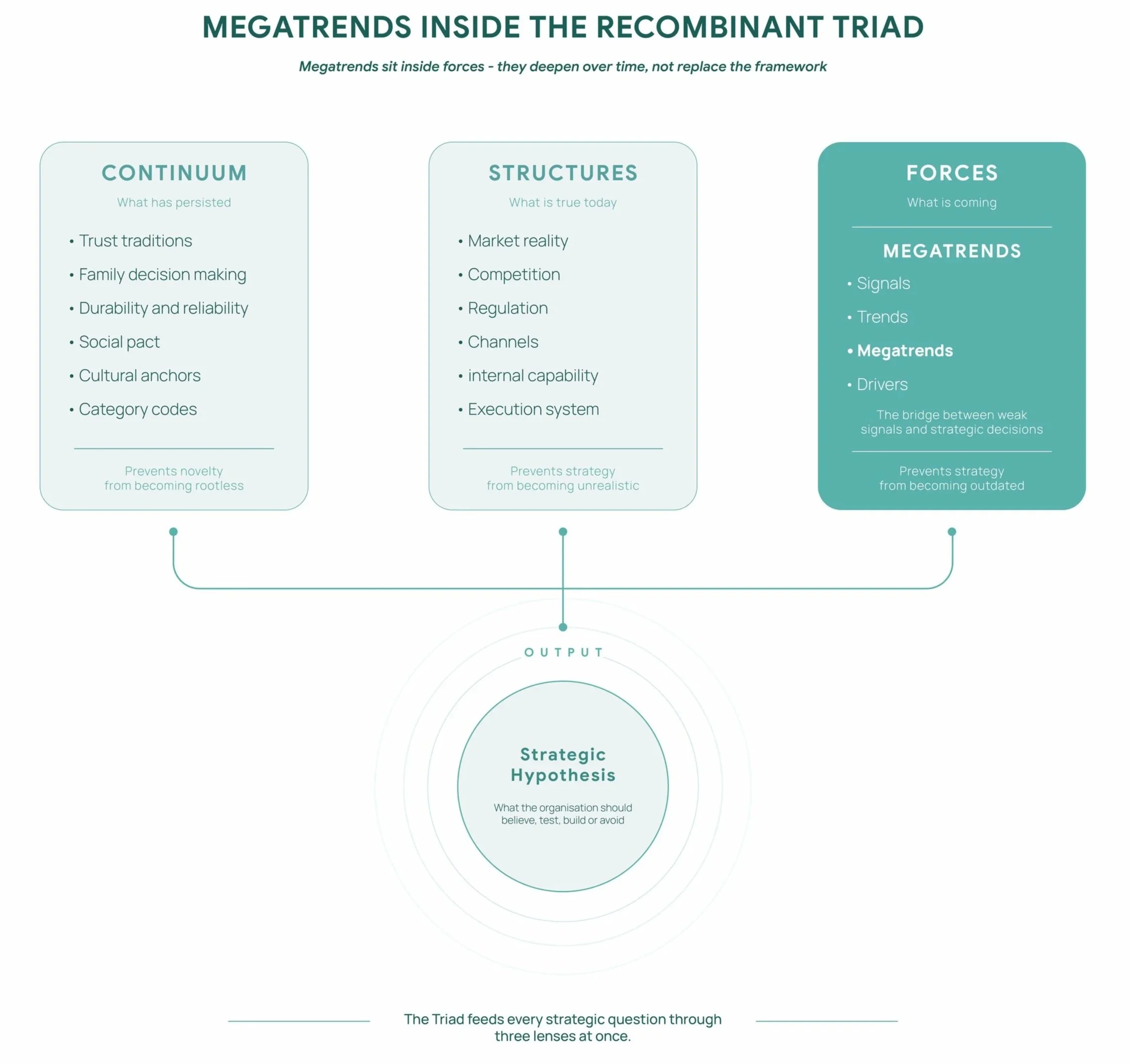
The Recombinant Triad reads every strategic question through three lenses: Continuum, Structures, and Forces. Continuum captures what has persisted, including long-held behaviours, values, category codes, and cultural anchors. Structures capture what is true today: the present reality of the organisation, market, competition, regulation, and execution system. Forces capture what is coming, namely directional change across technology, culture, economics, environment, policy, and behaviour.
Megatrends belong inside Forces because they map the long-term direction of change. But they earn their meaning only when read against the other two lenses.
A megatrend without Continuum drifts into the generic. It sounds global but feels nowhere. A megatrend without Structures collapses into the unusable: true in the world, impossible inside the organisation today. Strong strategy holds all three at once.
Consider “ageing India.” The megatrend is fixed. Its strategic meaning shifts by context. In healthcare, it points to home-based chronic care. In banking, it points to safer assisted transactions. In housing, it points to lift access, nearby care, and multigenerational layouts. In consumer technology, it points to voice-led interfaces and trust-by-design. The megatrend is the same. The strategy bends to category reality, organisational readiness, and Indian social patterns.
______________________________________________________________________________
Signals: First Flickers of Change
A signal is an early sign of change. It is usually small. It surfaces in one neighbourhood, one platform, one user group, one policy proposal, one startup, one cultural moment. A signal does not prove the future has arrived. It hints that something is shifting.
Signals appear as new behaviours among small user groups, fringe product or service models, policy experiments, shifts in language or aspiration, workarounds people invent because the current system fails them, and new infrastructure layers that quietly redraw what is possible.
The role of foresight is not to collect strange examples. It is to ask what each signal reveals.
A useful signal carries three qualities. It is observable (something is happening in the real world). It is directional (it points toward a larger shift). It is transferable (it can plausibly move from one context to another).
Indian example: assisted digital payments
A small shopkeeper helping an elderly customer complete a UPI payment is a signal. On its own, it is just a moment of help. But when similar moments cluster across kirana stores, clinics, ration shops, bus depots, and family settings, the signal sharpens. Digital adoption stops being only about access to technology. It becomes a question of trust, confidence, language, and assistance.
The scale is real. NPCI recorded 22.64 billion UPI transactions in March 2026, with a total value of ₹29.53 lakh crore. That is a 24 percent year-on-year jump in count and a 19 percent jump in value (NPCI, 2026).
The sharper signal is this: digital behaviour is becoming normal, but assisted trust is becoming the bridge for inclusion.
______________________________________________________________________________
Trends: Patterns Gathering Momentum
A trend is a pattern with momentum. It is bigger than a signal. It carries evidence across multiple contexts. It is visible in behaviour, business models, data, language, policy, and investment. A trend is not a one-off. It repeats.
A trend answers three questions. What is changing? Who is changing? Where is the change showing up?
From signal to trend
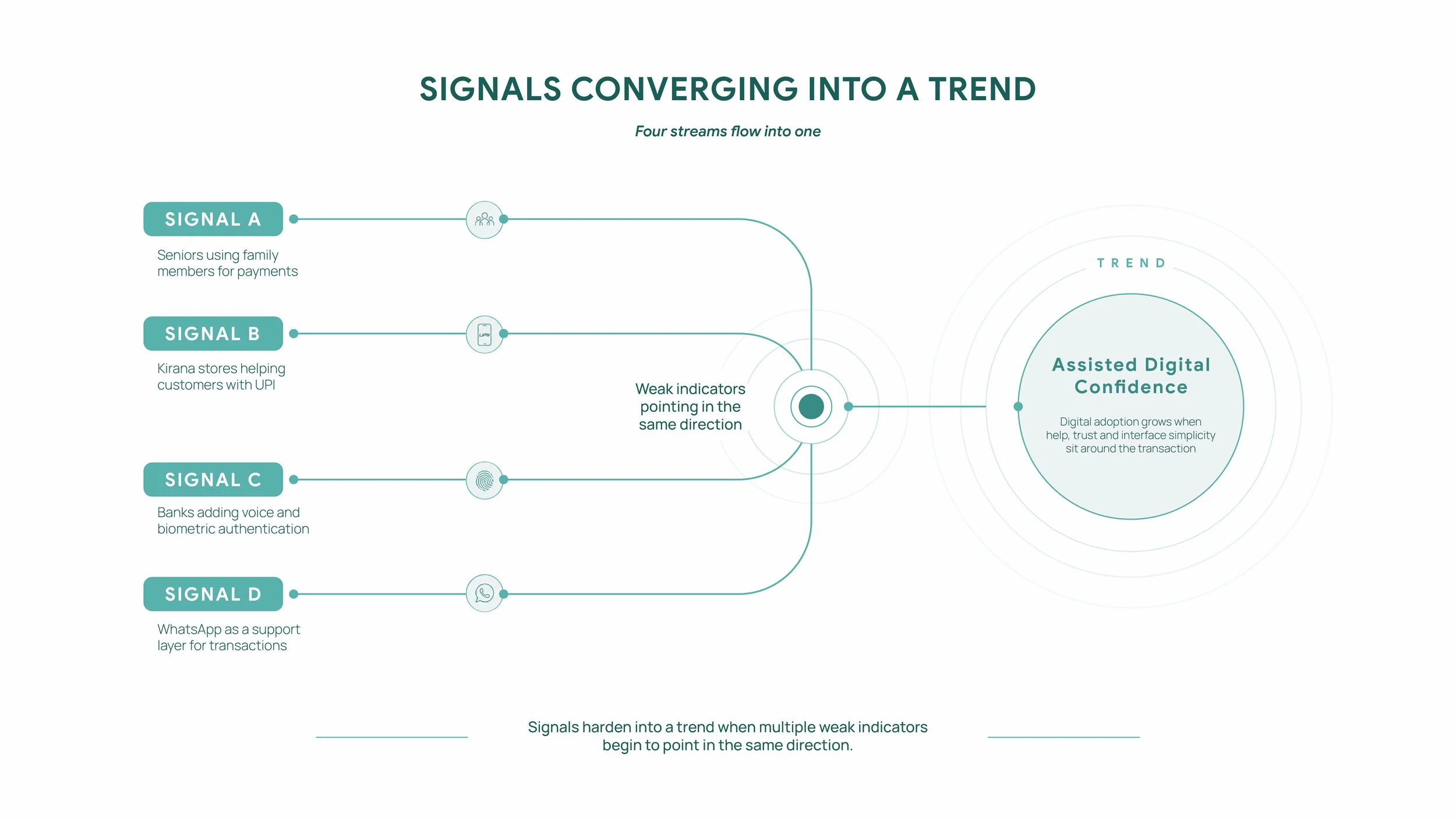
Signals harden into trends when multiple weak indicators point in the same direction.
One housing society creating a parcel room is a signal. Many apartment buildings redesigning lobbies for deliveries, groceries, laundry, service staff, and security protocols is a trend. One senior using WhatsApp voice notes to coordinate with a doctor is a signal. Many families running WhatsApp groups, teleconsultation, medicine delivery, and remote monitoring to manage elder care is a trend. One EV owner charging at a mall is a signal. The spread of charging infrastructure, fleet electrification, battery swapping, state EV policies, and consumer finance products is a trend.
Trend analysis decides whether a signal is an anomaly or the early expression of a wider pattern.
Megatrends: Currents That Reshape Systems
A megatrend is a long-term force that cuts across sectors and reshapes systems. It does not stay inside one category. It reaches businesses, governments, households, infrastructure, labour, capital, culture, and regulation.
The European Commission’s foresight work defines megatrends as long-term driving forces that are observable today and likely to shape the future significantly. Its Megatrends Hub uses them to help policymakers think about futures systemically (European Commission, n.d.). The OECD treats megatrend analysis as a foresight method for exploring large-scale changes across economies and societies, especially where impacts cut across multiple policy domains (OECD, n.d.).
Megatrends are not big trends. They are system-level shifts. A trend reshapes a category. A megatrend reshapes the conditions under which many categories operate.
From Signal to System: The Formation Ladder
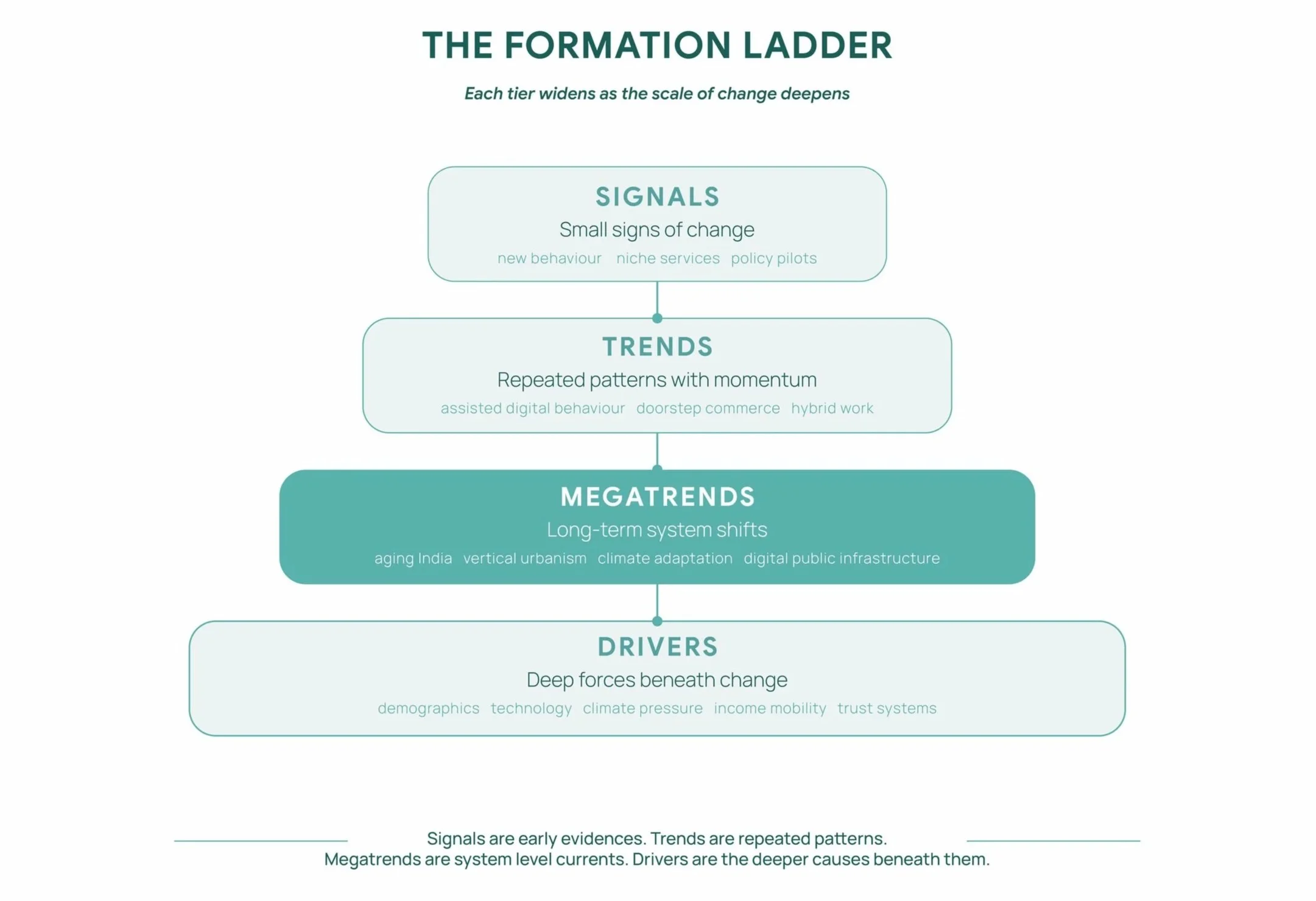
The relationship is simple. Signals are early evidence. Trends are repeated patterns. Megatrends are system-level currents. Drivers are the deeper causes beneath them.
Megatrends sit inside Forces, not outside the Triad. They do not replace the framework. They deepen one part of it.
The Seven-Step Synthesis
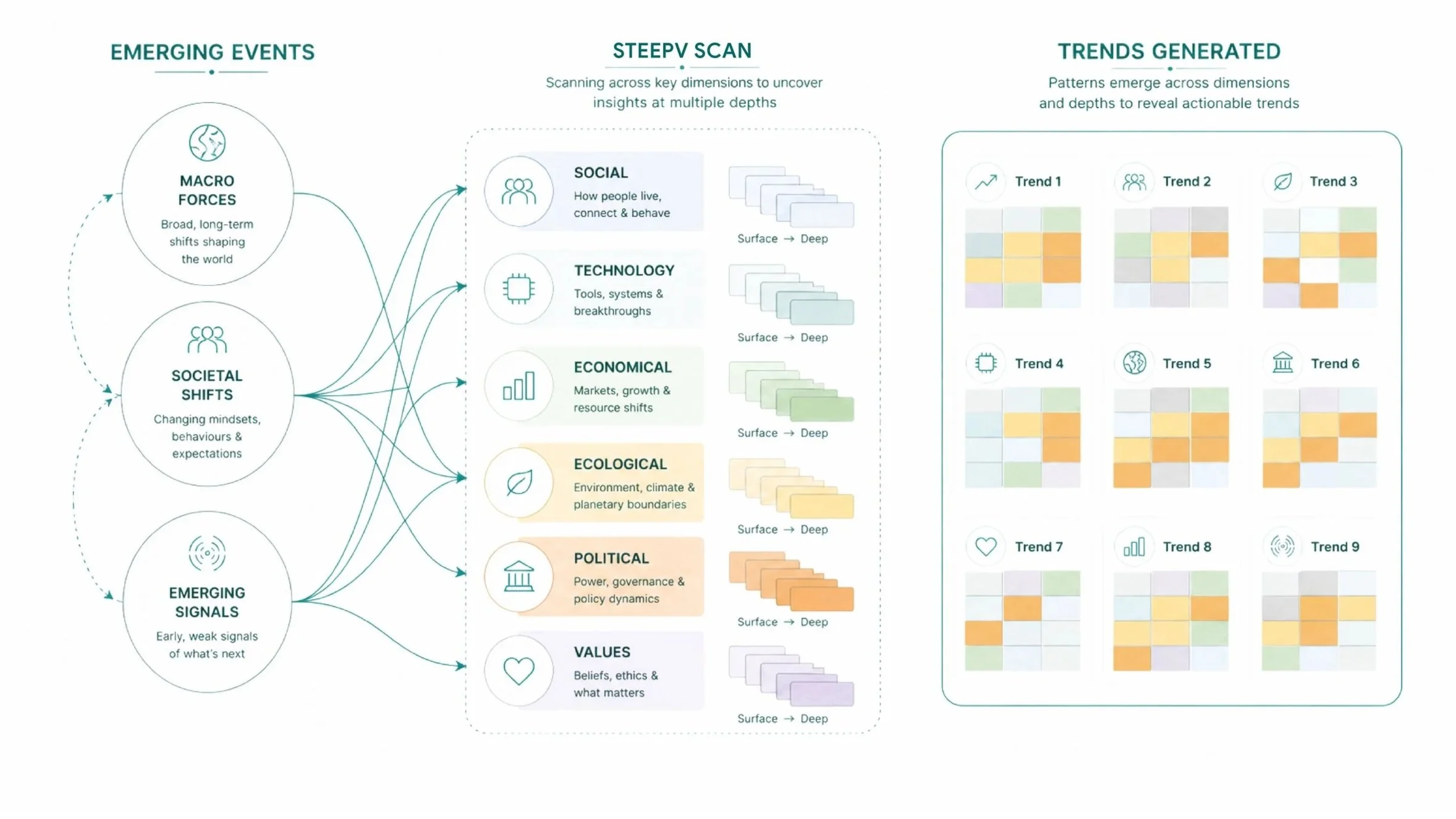
Megatrend analysis is not a brainstorming exercise. It is a structured synthesis. It moves through seven steps.
1. Define the strategic question: from vague to sharp
The work begins with a sharp question. A weak question, such as “What is the future of India?”, produces a weak scan. A stronger question, such as “What long-term shifts will reshape how urban Indian households manage care, consumption, mobility, and money between 2026 and 2036?”, produces a focused one. The sharper the question, the better the scan.
2. Scan for signals: across many fields
Signals are gathered across many sources: user interviews, expert conversations, startup activity, patents, policy documents, investment flows, academic research, media shifts, cultural behaviour, infrastructure changes, retail observation, platform data, and field immersion.
UNDP’s Future Trends and Signals System uses horizon scanning to capture signals and trends across climate, technology, governance, and development, organised through the STEEP frame: Social, Technological, Economic, Environmental, and Political (UNDP, n.d.).
For India, the scan must move beyond metros. Many important signals first surface in tier 2 and tier 3 cities, peri-urban regions, small businesses, informal markets, government service points, family networks, and everyday workarounds.
3. Cluster signals into themes
Signals are grouped by underlying behaviour or system change. Signals around medicine delivery, teleconsultation, diagnostic camps, and family WhatsApp groups cluster into “distributed care.” Signals around UPI, ONDC, account aggregators, and embedded credit cluster into “public rails for private innovation.” Signals around apartment parcel rooms, doorstep staff, gated society apps, and home services cluster into “threshold commerce.” Signals around heat stress, water scarcity, insurance, and construction materials cluster into “climate adaptation as everyday infrastructure.”
This is where raw material becomes meaningful.
4. Identify trends: from theme to momentum
A theme becomes a trend only when it shows momentum. Momentum surfaces through repetition across geographies, adoption across user groups, investment activity, policy support, infrastructure buildout, business model formation, cultural language, and measurable behaviour change.
A trend should be named clearly. The name explains the change, not decorates it. “Smart Living” weakens into wallpaper. “Assisted Home Autonomy” lands. “Digital India” diffuses. “Everyday Digital Infrastructure” specifies. “Wellness Economy” signals nothing. “Preventive Health as Household Management” carries weight.
5. Connect trends and megatrends
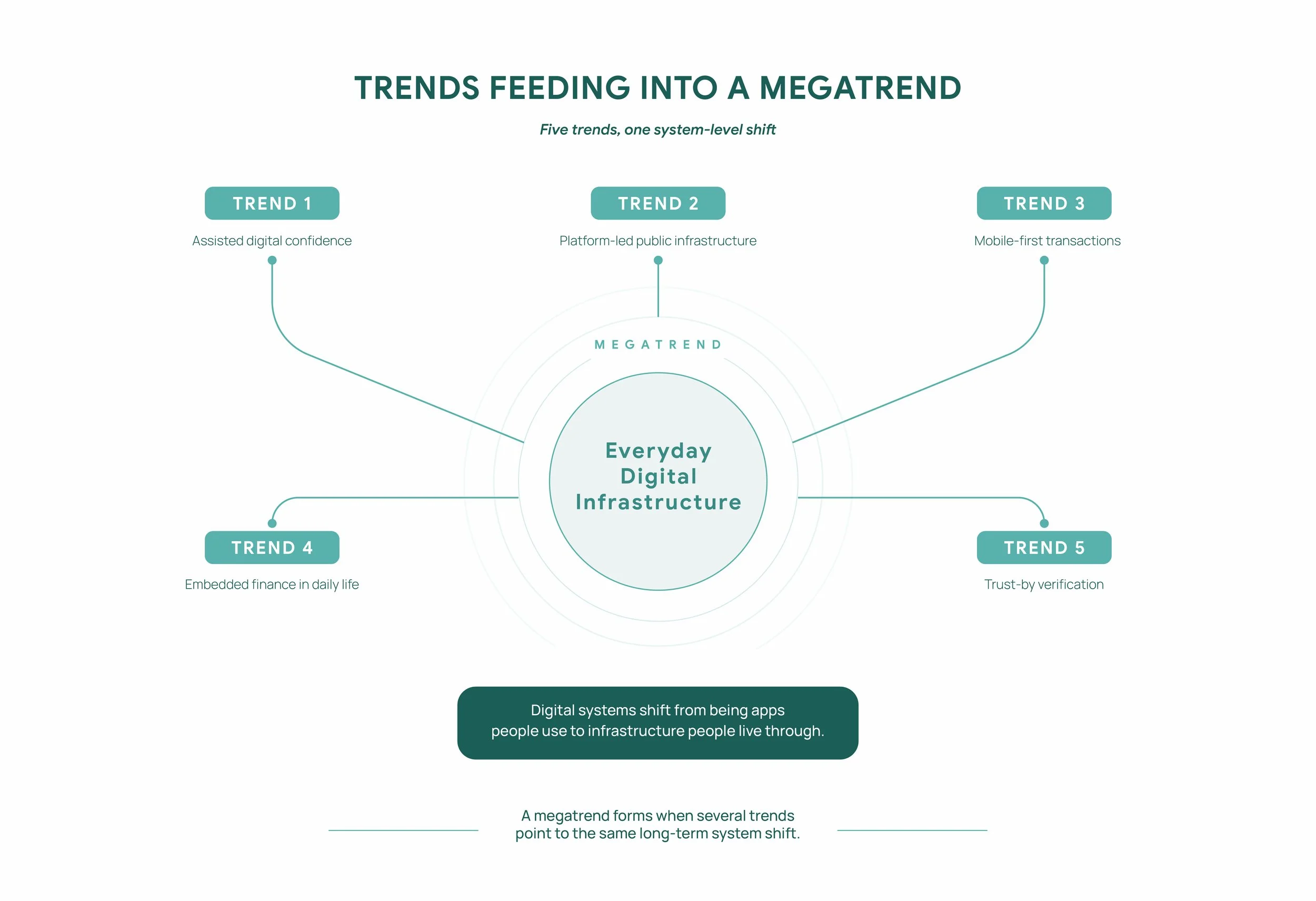
Megatrends form when several trends point to the same long-term system shift.
Take elder care. The signals: elderly users relying on children for app-based tasks, growth in at-home diagnostics, housing societies adding medical help desks, more chronic disease management through phones, insurance products moving toward prevention. The trends: assisted digital confidence, distributed healthcare, home as care infrastructure, preventive health management, and family-led elder support. The megatrend: The Ageing Household Economy.
This megatrend is not only about older people. It reshapes housing, insurance, banking, food, mobility, healthcare, labour, product design, family roles, and government welfare. UNFPA India’s India Ageing Report 2023 projected that the share of the population aged 60 and above will rise from 10.5 percent in 2022 to 20.8 percent in 2050, an absolute number of around 347 million. The 80-plus group will grow by 279 percent between 2022 and 2050, with a predominance of widowed and highly dependent very old women (UNFPA India and IIPS, 2023).
That is the demographic fact. The megatrend is what happens when the fact starts reshaping markets, households, care models, and public systems.
6. Identify drivers: the forces beneath
Drivers sit beneath megatrends. They explain why the change is happening. The common ones cluster around demographic change, climate pressure, technology diffusion, income mobility, urban density, gender role shifts, policy reform, infrastructure expansion, trust breakdown or rebuilding, and changes in aspiration.
A megatrend without drivers is a label. A megatrend with drivers is a strategic explanation.
7. Translate megatrends into strategic implications
This is where foresight becomes useful. Each megatrend translates into what changes for customers, what changes for the category, what changes for the company, what changes for policy, what risks rise, what opportunities open, what signals to track next, and what bets to test.
The work is not finished when the map is built. It is finished when leaders know what to do differently.
______________________________________________________________________________
How Megatrends Reshape Business
Megatrends change the basis of competition. They affect what customers value, what channels matter, what capabilities companies need, and what risks become material.
Customer expectations shift
When digital payments become everyday infrastructure, customers no longer treat fast payment as a feature. They treat it as a basic condition of trust. When heat stress becomes ordinary in cities, cooling, hydration, shade, insurance, work timing, mobility, and housing design all shift together. When households age, convenience alone fails. Products need safety, assistance, legibility, reliability, and family visibility.
Category boundaries dissolve
A bank now competes with a messaging app, a wallet, a lending platform, and a government identity layer. A hospital now competes with at-home diagnostics, pharmacies, wellness platforms, insurance apps, and family care coordinators. A real estate developer no longer competes only on location and square footage. Air quality, heat resilience, elder access, EV charging, delivery infrastructure, and community management have entered the contest. Megatrends dissolve old category lines.
Capability requirements change
A company may not need only better marketing. It may need new data systems, partnerships, service design, policy intelligence, field sensing, climate resilience, or assisted user support.
A consumer finance company responding to ageing India may need larger fonts and simpler flows, family consent structures, fraud protection, voice-led support, offline assistance, relationship manager models, clear escalation paths, and trust-building communication. The strategic implication is not “serve seniors.” It builds assisted trust into the operating model.
Investment priorities reshape
Megatrends help companies decide what to build before demand becomes obvious. India’s renewable energy push is not just a sector trend. India crossed 50 percent non-fossil installed power capacity in June 2025, five years ahead of its Paris commitment, reaching 262.74 GW of non-fossil capacity by November 2025 on the path toward a 500 GW target by 2030 (PIB, 2025). This carries implications for manufacturing, storage, grid infrastructure, EV charging, industrial decarbonisation, green jobs, financing, and state-level competitiveness.
A company reading this only as “green energy growth” misses the wider shift. The deeper megatrend is energy transition as industrial restructuring.
______________________________________________________________________________
How Megatrends Reshape Policy
Governments use megatrends to make policy more future-ready. The OECD describes strategic foresight as a way to help governments explore multiple plausible futures, anticipate opportunities and risks, and build resilient policy (OECD, n.d.). Megatrends matter here because many public systems still run on yesterday’s assumptions.
Future pressure points become visible
Ageing reshapes pensions, healthcare, housing, transport, public spaces, and digital inclusion. Urbanisation reshapes land use, water demand, waste systems, mass transit, heat risk, and housing supply. Climate change reshapes agriculture, insurance, energy demand, labour productivity, health, and city planning. Digital infrastructure reshapes identity, payments, welfare delivery, competition, privacy, fraud, and citizen access.
Policy interdependence surfaces
No major megatrend belongs to one ministry. Urban heat is not only an environmental issue. It is a labour issue, a health issue, a housing issue, an energy issue, and a city finance issue. Ageing is not only a social justice issue. It is a healthcare, insurance, housing, mobility, labour, and digital services issue. Megatrends force policy to move from siloed planning to system planning.
Anticipatory governance becomes possible
Policy often reacts after pressure becomes visible. Megatrend analysis lets governments act earlier. The World Bank’s Towards Resilient and Prosperous Cities in India notes that India’s urban population will almost double from 480 million in 2020 to 951 million by 2050, requiring more than 144 million new homes by 2070 and over $2.4 trillion in resilient infrastructure investment by 2050. With more than half of the urban infrastructure for 2050 still to be built, timely adaptation can help cities avoid large future losses from climate shocks (World Bank, 2025). That is exactly where megatrend thinking earns its place: it links today’s signals to tomorrow’s infrastructure needs.
______________________________________________________________________________
Four Megatrends Reshaping India
Megatrend 1: Everyday Digital Infrastructure
Digital is no longer a separate layer of life. It is becoming part of how Indians pay, prove identity, access services, borrow, sell, learn, and manage relationships.
Signals cluster around QR codes at small shops, UPI use by street vendors, biometric authentication, WhatsApp-based commerce, assisted payments, and government service digitisation. Trends include embedded finance, assisted digital behaviour, platform-led commerce, low-ticket digital transactions, and trust-by-verification.
The megatrend is larger: digital public and private rails are becoming everyday infrastructure.
For business, trust becomes a design problem, not just a brand problem. Assisted onboarding becomes critical for inclusion. Payments, identity, credit, and commerce begin to merge. Small merchants become digitally visible. Fraud prevention becomes part of customer experience.
For policy, digital literacy matters as much as digital access. Grievance systems must keep pace with adoption. Data protection and consumer protection move to the centre. Public digital infrastructure becomes a competitive asset.
Megatrend 2: The Ageing Household Economy
India is still young, but it is also aging. The shift will not arrive evenly. Some states, cities, and income groups will age faster than others.
Signals cluster around elderly users needing help with apps, growth in home diagnostics, family-led medical coordination, senior living formats, medicine subscriptions, and care work becoming organised. Trends include distributed care, assisted digital access, chronic disease management, multigenerational planning, and home-based health infrastructure.
The megatrend is larger: the household becomes the primary site of aging, care, finance, and health coordination.
For business, products must serve both the user and the caregiver. Trust, safety, and legibility become premium markers. Healthcare shifts from episodic treatment to continuous management. Insurance and banking need family-aware service models. Housing must support aging in place.
For policy, elder care cannot lean only on hospitals. Public health, housing, mobility, and digital inclusion need to connect. Women’s unpaid care work needs recognition. Local care infrastructure becomes more important.
Megatrend 3: Vertical Urbanism
Indian urban life is moving upward, inward, and into denser formats. The city is no longer organised only by roads, markets, and neighbourhoods. It is organised by towers, gated societies, lobbies, lifts, basements, service elevators, parcel rooms, and app-managed communities.
Signals cluster around package rooms, society apps, doorstep services, elevator logistics, tower-based social groups, vertical retail delivery, and building-level security protocols. Trends include threshold commerce, micro-logistics, managed communities, high-rise ageing, and building-as-platforms.
The megatrend is larger: urban life is being reorganised along the vertical axis.
For business, the doorstep becomes a channel. Building access becomes part of distribution strategy. Packaging must work for elevators, guards, and storage rooms. Services need society-level partnerships. Premium housing is judged by management quality, not only amenities.
For policy, fire safety, waste, water, parking, cooling, and delivery systems need new standards. Urban planning must treat buildings as social and logistical systems. Public services need to reach vertical communities efficiently.
Megatrend 4: Climate Adaptation as Everyday Infrastructure
Climate change is moving from a distant risk to an everyday operating condition.
Signals cluster around heat action plans, cooling demand, water tanker dependence, flood insurance, rooftop solar, reflective paint, water-saving appliances, and city-level resilience projects. Trends include heat adaptation, resilient housing, decentralised energy, water security, climate-linked insurance, and sustainable mobility.
The megatrend is larger: climate resilience becomes part of how households, companies, and governments plan basic infrastructure.
For business, cooling, water, energy efficiency, and resilience become value drivers. Supply chains need climate stress testing. Insurance products need new risk models. Real estate must account for heat, flooding, and resource stress. Brands will be judged on practical resilience, not generic sustainability claims.
For policy, climate adaptation must enter urban planning, labour policy, health systems, and housing regulation. Heat and flood preparedness need local execution. Energy transition demands grid readiness, storage, finance, and state capacity.
______________________________________________________________________________
How Megatrends Strengthen the Triad
Megatrend analysis deepens the Forces lens. It does not replace the Triad.
The Triad protects strategy from three common errors. Continuum prevents the future from becoming rootless. Structures prevent foresight from becoming unrealistic. Forces prevent strategy from becoming outdated.
Megatrends sit inside Forces as the bridge between weak signals and strategic decisions. They help organisations see which changes are small, which are growing, and which are powerful enough to reshape the conditions of competition.
The final output is not a list of megatrends. The final output is a sharper strategic hypothesis.
Worked example
Continuum: Indian households build trust through family validation, repeated reliability, and known intermediaries.
Structures: Digital adoption is high, but confidence, fraud anxiety, language barriers, and assisted use still shape behaviour.
Forces: Everyday digital infrastructure and trust-as-verification are becoming megatrends.
Strategic hypothesis: The next wave of digital growth in India will not be won by the fastest interface alone. It will be won by systems that combine speed with assistance, verification, and human fallback.
That is where megatrend analysis becomes a strategy. It turns the future from a vague direction into a set of choices.
______________________________________________________________________________
References
European Commission. (n.d.). The Megatrends Hub. Knowledge for Policy. Retrieved April 30, 2026, from https://knowledge4policy.ec.europa.eu/foresight/tool/megatrends-hub_en
National Payments Corporation of India. (2026). UPI product statistics: Monthly metrics. NPCI. https://www.npci.org.in/statistics/monthly-metrics
Organisation for Economic Co-operation and Development. (n.d.). Strategic foresight. OECD. Retrieved April 30, 2026, from https://www.oecd.org/en/about/programmes/strategic-foresight.html
Press Information Bureau, Government of India. (2025, December). 2025 marks highest-ever renewable energy expansion in India’s energy transition journey. Ministry of New and Renewable Energy. https://www.pib.gov.in/PressReleasePage.aspx?PRID=2209478
United Nations Development Programme. (n.d.). UNDP’s Future Trends and Signals System. UNDP. Retrieved April 30, 2026, from https://www.undp.org/future-development/undps-future-trends-signals-system
UNFPA India and International Institute for Population Sciences. (2023). India ageing report 2023: Caring for our elders. Institutional responses. United Nations Population Fund India. https://india.unfpa.org/sites/default/files/pub-pdf/20230926_india_ageing_report_2023_web_version_.pdf
World Bank. (2025). Towards resilient and prosperous cities in India. World Bank Group. https://documents.worldbank.org/en/publication/documents-reports/documentdetail/099052225091510119
______________________________________________________________________________
Do explore our research-backed perspectives on change, innovation, and what’s emerging next

TURIAN LABS
JANUARY 2026

NOVEMBER 2025
TURIAN LABS