
When Commerce Serves State Power - Again!
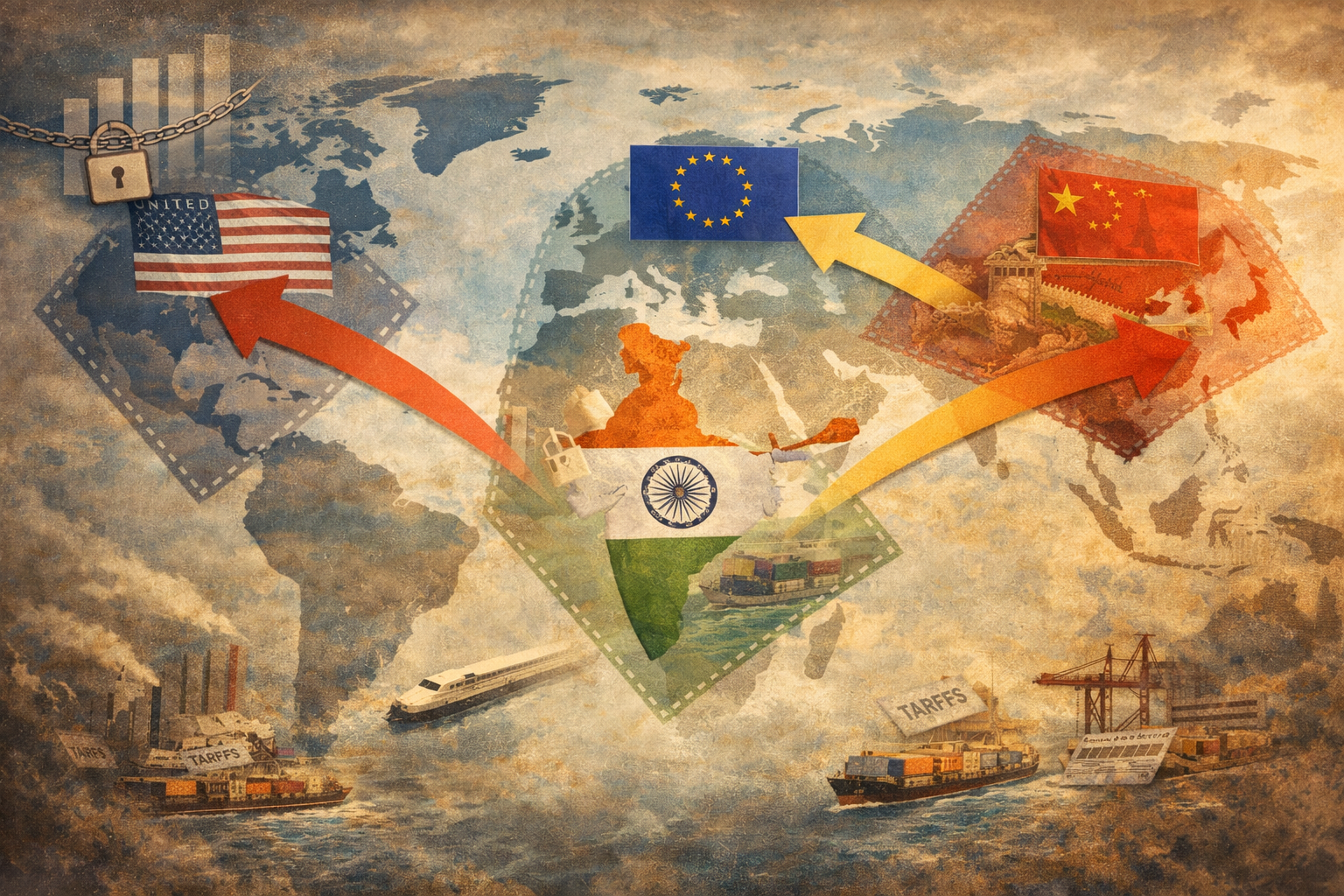
Authors: Debaditya Jena & Manoj Kothari
Are we witnessing the end of free trade as we knew it?
Has commerce once again become an arm of statecraft?
And in a world of subsidy wars and supply-chain rivalries, where do middle powers stand?
In the early 17th century, the Dutch East India Company fused commerce and coercion. Chartered by the state, it commanded warships, monopolised trade routes and redirected wealth from Asia to Amsterdam. Trade was not an end in itself, it was a means of strengthening the state.
The company is long gone. The logic has returned. That logic has a modern name: neo-mercantilism.
Canadian Prime Minister Mark Carney recently observed that nations can no longer live within the fiction of mutual benefit when integration becomes subordination - capturing a widening anxiety among middle powers.
What is really happening?
Today, China represents the clearest expression of neo-mercantilism. Through state-directed finance, industrial subsidies and tight control of domestic markets, Beijing has pursued dominance in electric vehicles, batteries and advanced manufacturing. Its grip over rare earth processing and battery supply chains gives it leverage in the global green transition. Economic scale is deliberately converted into strategic influence.
The United States, once the chief architect of globalisation, has pivoted sharply. Tariffs, export controls and industrial policy are no longer temporary correctives but instruments of national security. The CHIPS Act and the Inflation Reduction Act, alongside tighter scrutiny of outbound investment, seek not only to revive domestic industry but also to slow China’s technological ascent. Washington and Beijing now deploy similar tools, even if they justify them differently.
Mercantilist thinking is not alien to India's past. The Arthashastra treated trade as central to statecraft, while the Chola Empire embedded commerce within imperial expansion. What distinguishes the present is not the return of the state, but the scale and simultaneity of this shift.
For three decades after the Cold War, global policy rested on a simple assumption. Integration would maximise efficiency and reduce conflict. Supply-chains would bind rivals into mutual dependence. Trade would civilise power politics. That belief has fractured.
The pandemic exposed the fragility of hyper-efficient production networks. Lockdowns and logistics breakdowns triggered inflation and shortages across continents. Governments realised that just-in-time efficiency had created systemic vulnerability. Stockpiling and redundancy returned to favour. The language shifted from optimisation to resilience.
The war in Ukraine accelerated the transformation. Energy flows were weaponised. Payment systems became instruments of coercion. The freezing of Russia’s foreign exchange reserves demonstrated that access to the dollar system is conditional, not guaranteed. Sanctions on Russia, Belarus, Iran and Venezuela revealed that the global financial architecture itself can serve strategic ends. Economic interdependence proved to be both a bridge and a lever.
Policymakers drew a blunt lesson. CONTROL over chokepoints and not INTEGRATION, creates leverage. Semiconductors, minerals, energy infrastructure, logistics corridors and financial rails are no longer neutral commercial assets. They are strategic terrain.
India is often portrayed as a beneficiary of supply-chain diversification. As companies seek alternatives to China, India’s scale, labour-force and democratic credentials appear attractive. Apple’s expansion of iPhone assembly and Production-Linked Incentive scheme (PLI) in electronics are cited as evidence. A domestic market of 1.47 billion consumers (total population of India) or let’s say ~130-140mn ‘active consumer class’ with high-disposal income, provides internal ballast when export demand weakens. Yet optimism must be tempered by structural realities. India’s trade-to-GDP ratio stands at about 45 percent. It is lower than Canada’s but higher than Brazil’s. India is embedded in global networks where standards, capital flows and technology access are shaped largely by Washington and Beijing. Even formal non-alignment does not insulate an economy from rule systems it did not design.
Market access increasingly comes with expectations. Technology partnerships carry security clauses. Capital flows respond to geopolitical signals. Economic growth, in a neo-mercantilist world, is not purely a function of competitiveness. It is shaped by power geometry.
Three pathways for neo-mercantilism
Three broad pathways emerge from here:
The first is the branch economy. Middle powers remain integrated but largely as dependent nodes within rival ecosystems. Supply chains reorganise under political pressure. Sanctions and counter-sanctions become routine. Growth continues, yet value capture remains limited. Countries function as manufacturing platforms or resource suppliers within larger strategic designs. Think Vietnam or India in semiconductor assembly or Mexico in automotive manufacturing - growing, but not controlling. Policy autonomy narrows as governments balance growth against vulnerability.
The second is strategic indispensability. Taiwan's dominance in advanced chips or South Korea's position in batteries shows how irreplaceability creates negotiating power.This requires building capabilities that are difficult to substitute. When partners cannot easily replace your contribution, leverage shifts. For India, this could mean deepening electronics manufacturing, strengthening digital public infrastructure, consolidating pharmaceutical leadership and investing in green mobility. It demands macroeconomic stability, skill formation and active participation in setting standards rather than merely adopting them. Integration, in this scenario, becomes insurance rather than exposure.
The third is managed isolation. A state attempts to onshore strategic sectors, diversify partnerships and minimise entanglement, as Russia is a case in point in the post-sanctions world. In practice, this path is hard to sustain. Financial systems, semiconductor ecosystems and AI platforms are increasingly aligned along geopolitical lines. Isolation risks technological lag and capital volatility. Over time, economic constraints may force alignment under less favourable terms.
None of these roads is predetermined. But the direction of travel is clear. Commerce is once again serving state power. The rules-based order that privileged efficiency above all else is giving way to a system where resilience, leverage and control matter more.
The Road ahead for India
For India and other middle powers, the challenge is subtle but urgent. Engagement with global markets remains essential. Yet engagement without strategy risks subordination. Growth alone will not secure autonomy. Economic policy must now think in strategic layers. Which sectors are critical? Where are the chokepoints? How much redundancy is affordable? Which partnerships enhance agency rather than dilute it?
The age of frictionless globalisation is over. What replaces it will not be pure protectionism, but a world in which markets and power are openly intertwined. The question for middle powers is not whether commerce will serve the state. It is whether the state can shape commerce in ways that preserve sovereignty while sustaining growth. That balance will define the next phase of the global economy.
—---------------
Author Bios
Debaditya Jena is a foresight strategist with Turian Labs with experience in global affairs, and megatrends shaping the world order.
Manoj Kothari is the Founder and Chief Strategist at Turian Labs, a Design Thinking and Foresight consulting firm. He writes frequently on innovation, policy, and India's global positioning.